Introduction
Engine valves are the "breathing system" of internal combustion engines, controlling the precise timing of air intake and exhaust gas expulsion. These critical components directly impact four key performance indicators: power output, fuel efficiency, emission levels, and overall reliability.
Whether you're a car enthusiast, mechanic, or vehicle owner, understanding engine valves is essential for maintaining optimal engine performance. This comprehensive guide covers everything you need to know about engine valves—from their basic function and types to materials, common problems, and maintenance best practices.
At TOPU, we've been manufacturing high-quality engine valves for over two decades, and we're here to share our expertise with you.
What Are Engine Valves?
Definition and Core Function
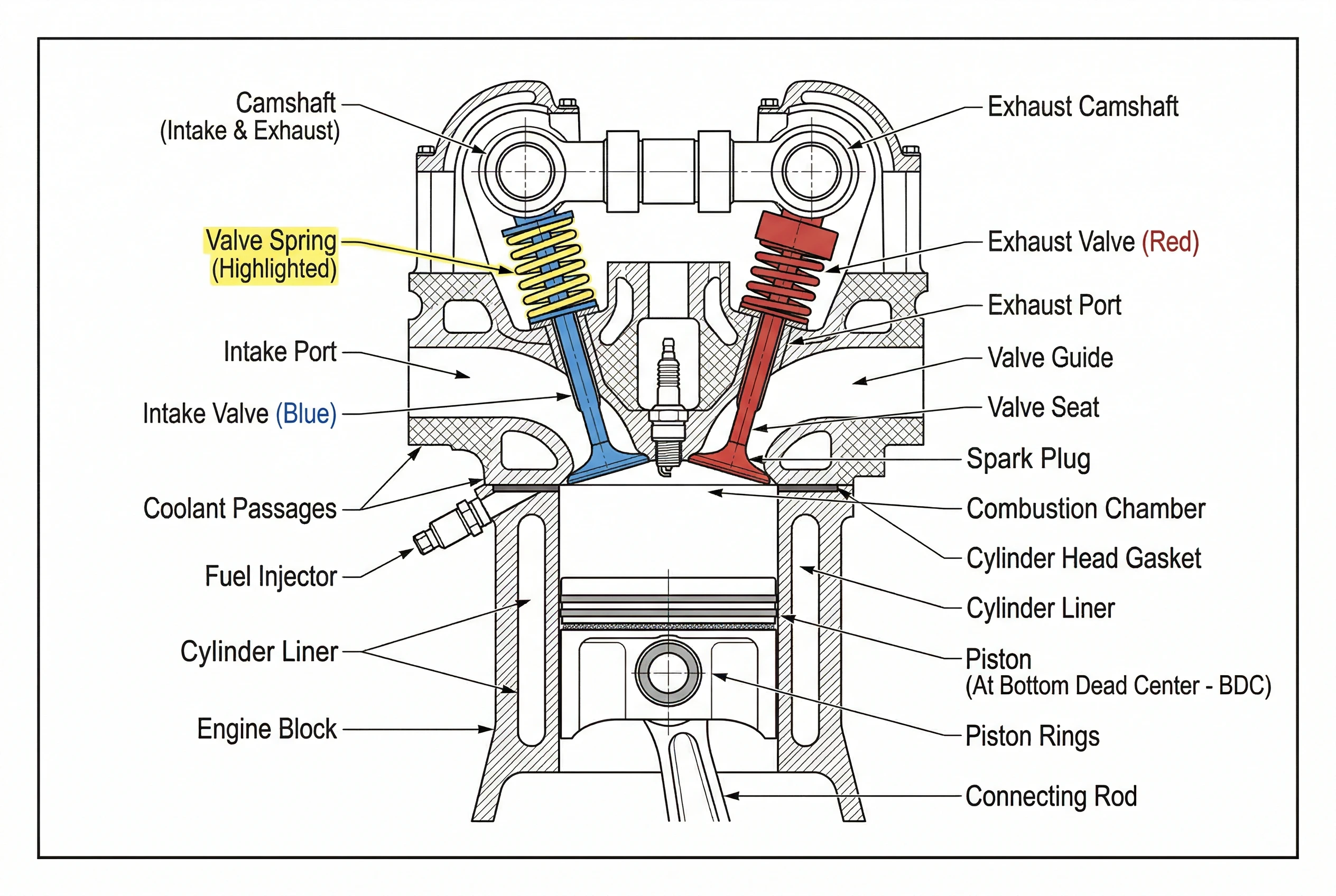
Engine valves are mechanical valves that control the flow of gases in and out of the combustion chamber. Located in the cylinder head, these precision-engineered components open and close at precisely timed intervals to regulate the engine's breathing cycle.
There are two primary types of valves in most engines:
Intake valves: Allow air and fuel mixture to enter the combustion chamber
Exhaust valves: Release burned gases after combustion
The basic principle is simple: valves open to allow gas flow and close to seal the combustion chamber, but the precision required is extraordinary—valves can open and close thousands of times per minute in a running engine.
Historical Evolution
Engine valve technology has evolved significantly over the past century:
Early Side Valve (Flathead) Engines: Valves positioned beside the cylinder, simple but inefficient
Overhead Valve (OHV): Valves moved to the cylinder head, improving efficiency
Overhead Cam (OHC): Camshaft positioned above valves, reducing moving parts
Modern DOHC: Dual overhead camshafts for independent intake and exhaust control
This evolution has been driven by the constant pursuit of better performance, fuel efficiency, and reduced emissions.
Role in the Four-Stroke Cycle
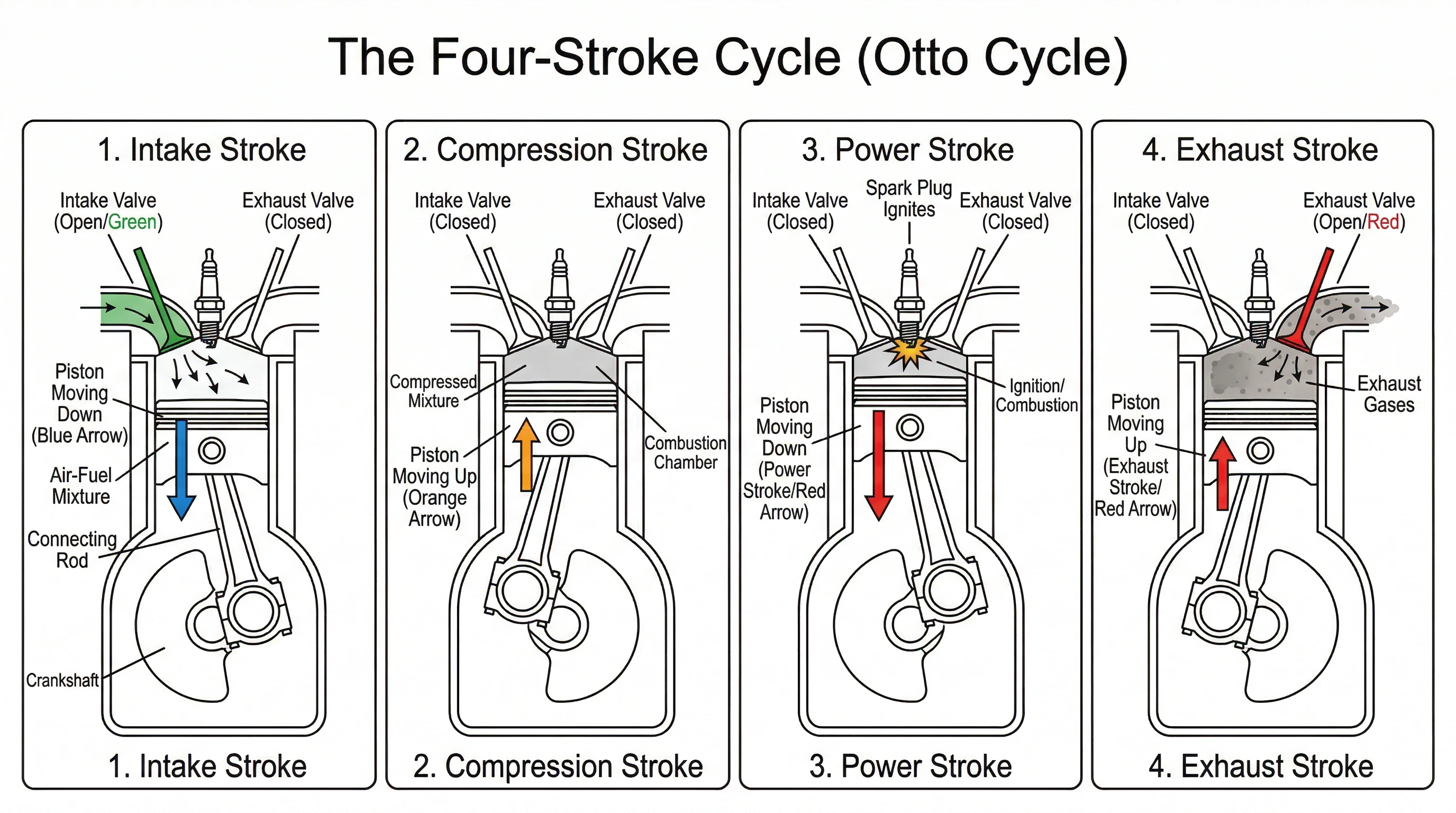
Engine valves play a crucial role in each phase of the four-stroke combustion cycle:
1. Intake Stroke
Intake valve opens
Piston moves downward
Air/fuel mixture enters the combustion chamber
Exhaust valve remains closed
2. Compression Stroke
Both valves close completely
Piston moves upward
Air/fuel mixture is compressed
Pressure and temperature increase
3. Power Stroke
Both valves remain closed
Spark ignites the compressed mixture
Combustion forces piston downward
Power is generated
4. Exhaust Stroke
Exhaust valve opens
Piston moves upward
Burned gases are expelled
Intake valve remains closed
Valve Timing and Overlap
Valve timing refers to when valves open and close relative to piston position. In modern engines, there's often a brief period called "valve overlap" when both intake and exhaust valves are slightly open simultaneously. This overlap helps scavenge exhaust gases and improve cylinder filling, enhancing performance and efficiency.
Advanced systems like Variable Valve Timing (VVT) can adjust this timing dynamically based on engine speed and load, optimizing performance across different driving conditions.
Learn more: Intake Valves | Exhaust Valves
Types of Engine Valves
By Function
Intake Valves
Intake valves control the entry of air and fuel mixture into the combustion chamber. Key characteristics include:
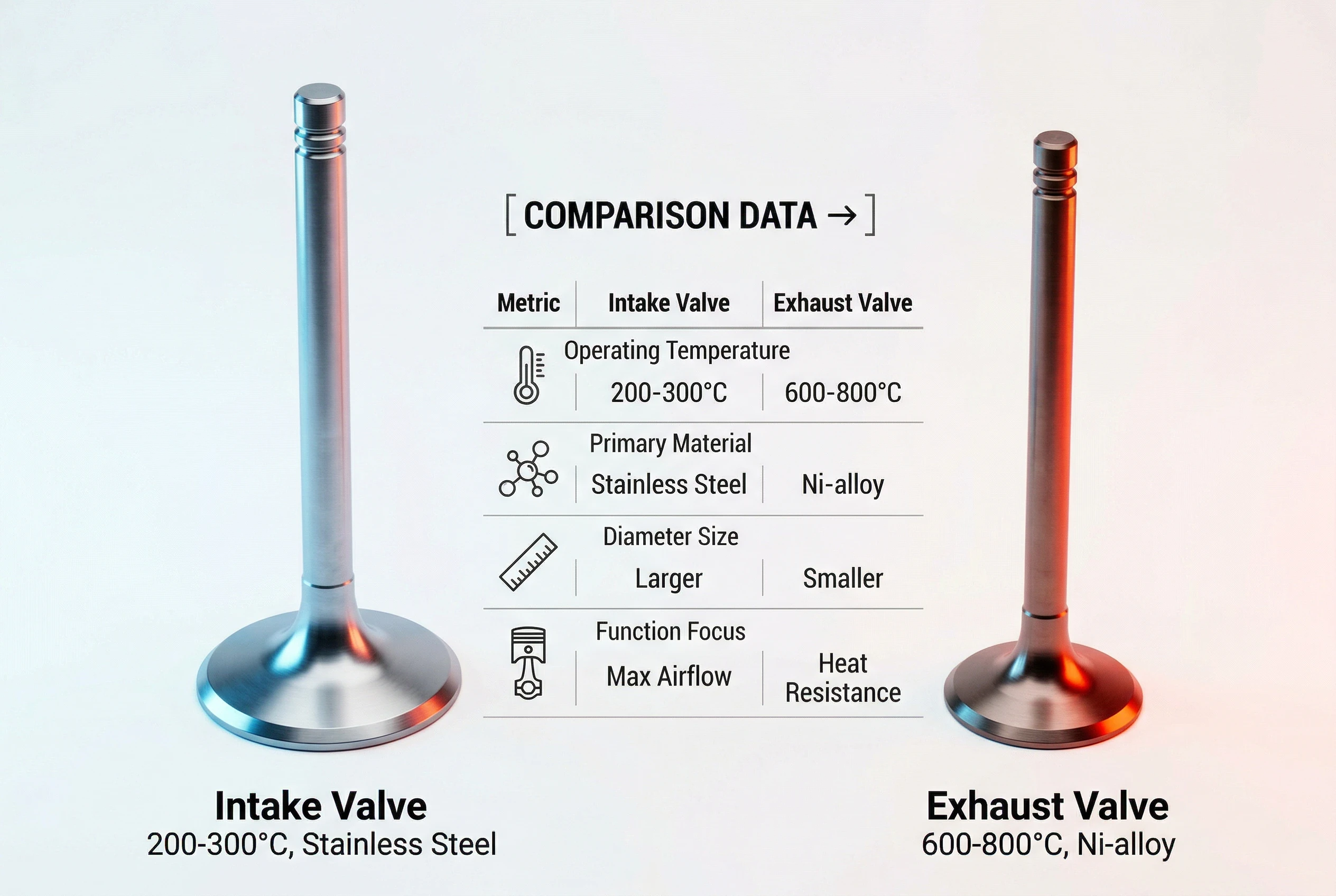
Larger diameter: Typically bigger than exhaust valves to maximize airflow
Lower operating temperature: Around 200-300°C (392-572°F)
Carbon buildup susceptibility: More prone to carbon deposits, especially in direct injection engines
Material: Usually stainless steel alloys
The larger size of intake valves is intentional—it's easier to get air into the cylinder than to expel exhaust gases, so intake valves are designed to maximize flow.
Detailed guide: Complete Intake Valves Guide
Exhaust Valves
Exhaust valves release burned gases from the combustion chamber. Their characteristics include:
Smaller diameter: Slightly smaller than intake valves
Extreme operating temperature: 600-800°C (1112-1472°F)
Higher material requirements: Must withstand extreme heat and corrosive exhaust gases
Material: Often nickel-based alloys or specialized stainless steel
Exhaust valves face the harshest conditions in the engine, directly exposed to hot combustion gases, which is why they require superior materials and often fail before intake valves.
Detailed guide: Complete Exhaust Valves Guide
Comparison Table
Feature | Intake Valves | Exhaust Valves |
|---|---|---|
Primary Function | Air/fuel intake | Exhaust gas expulsion |
Relative Size | Larger | Smaller |
Operating Temperature | 200-300°C | 600-800°C |
Common Problems | Carbon buildup | Burning and erosion |
Material | Stainless steel | Heat-resistant alloys |
Replacement Frequency | Less frequent | More frequent |
By Configuration
2-Valve Configuration (2V)
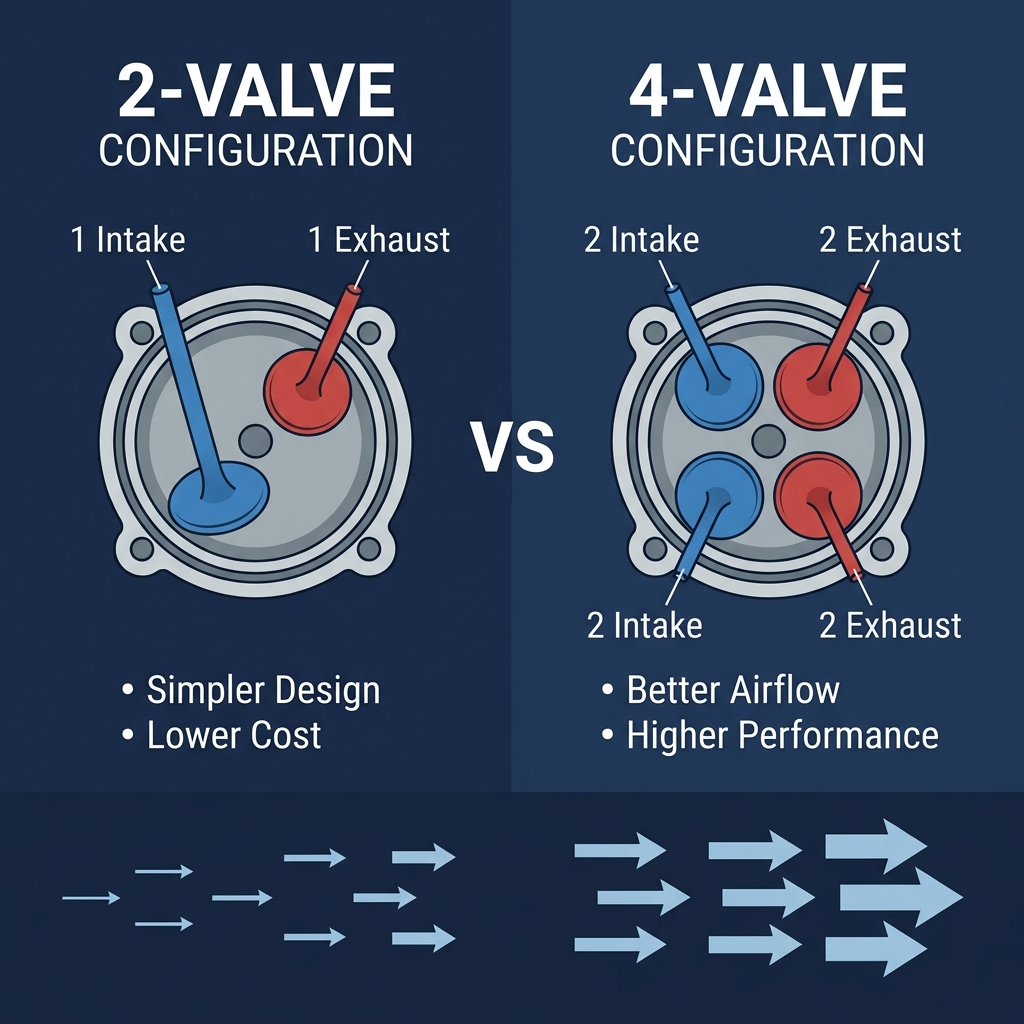
Setup: One intake and one exhaust valve per cylinder
Advantages: Simple design, lower cost, easier maintenance
Disadvantages: Limited airflow, lower performance potential
Applications: Economy vehicles, older engines, some diesel engines
4-Valve Configuration (4V)
Setup: Two intake and two exhaust valves per cylinder
Advantages: Better breathing efficiency, higher performance, improved fuel economy
Most common: Standard in modern engines
Applications: Most passenger cars, performance vehicles
The 4-valve design allows for better airflow because the total valve area is greater, even though individual valves are smaller. This configuration also allows for a more centrally located spark plug, improving combustion efficiency.
3-Valve and 5-Valve Configurations
Some manufacturers have experimented with alternative configurations:
3-Valve: Two intake, one exhaust (Ford Triton engines)
5-Valve: Three intake, two exhaust (some Audi and Volkswagen engines)
These configurations aimed to optimize airflow but added complexity. The 4-valve design has proven to be the best balance of performance, cost, and reliability.
By Actuation System
OHV (Overhead Valve): Valves in head, camshaft in block, uses pushrods
SOHC (Single Overhead Cam): One camshaft operates both intake and exhaust valves
DOHC (Dual Overhead Cam): Separate camshafts for intake and exhaust valves, allowing independent control
DOHC designs are most common in modern engines because they allow for better valve timing control and higher RPM capability.
Engine Valve Materials and Design
Material Requirements
Engine valves must meet demanding requirements:
High-temperature resistance: Especially for exhaust valves (up to 800°C)
Mechanical strength: Withstand repeated impacts and high combustion pressures
Corrosion resistance: Resist attack from combustion byproducts
Thermal conductivity: Efficiently transfer heat away from the valve face
Wear resistance: Maintain sealing surfaces over hundreds of thousands of cycles
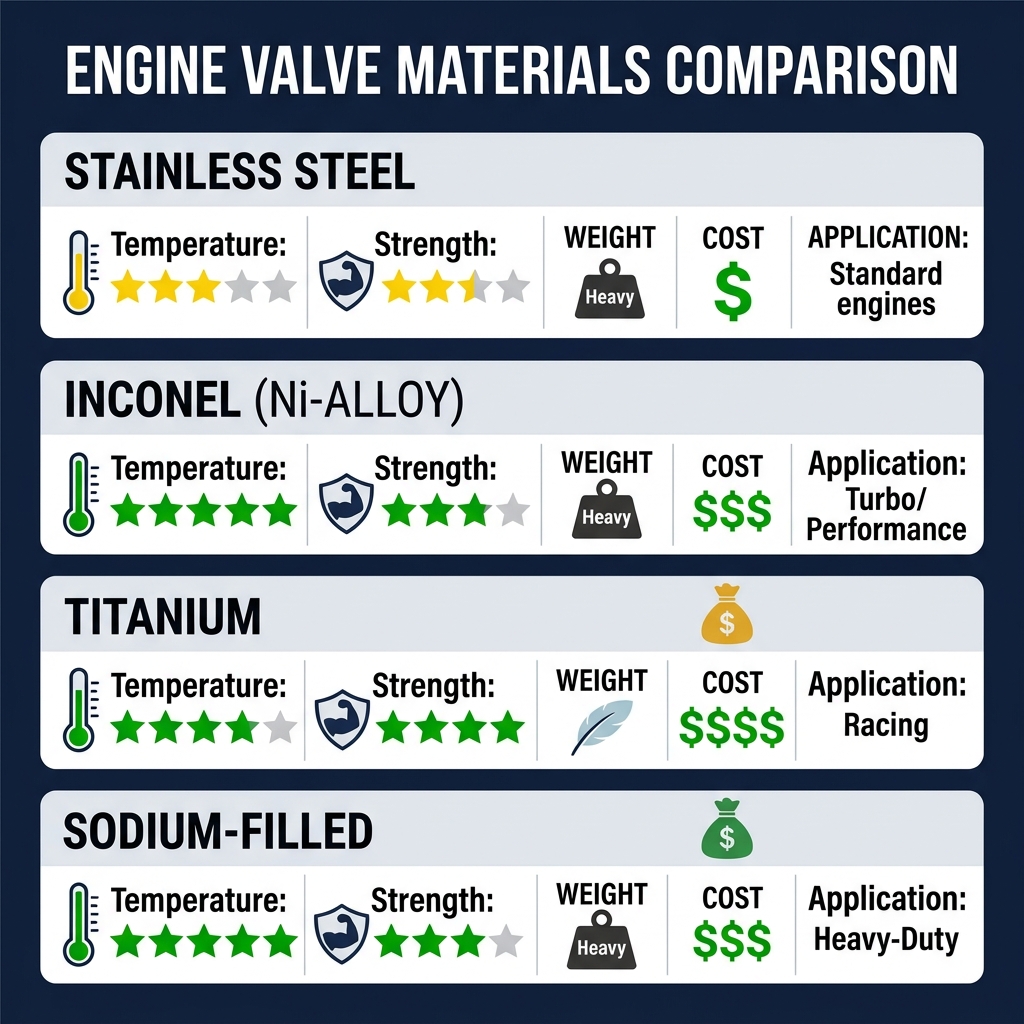
Common Materials
Intake Valve Materials
Stainless Steel Alloys (Most Common)
Composition: Chromium, nickel, and other alloying elements
Advantages: Good corrosion resistance, adequate strength, cost-effective
Applications: Standard passenger vehicles
Titanium Alloys (High-Performance)
Advantages: Lightweight (40% lighter than steel), high strength
Disadvantages: Expensive, requires special manufacturing
Applications: Racing engines, high-performance vehicles
Exhaust Valve Materials
Nickel-Based Alloys (Inconel)
Superior high-temperature performance
Excellent resistance to thermal fatigue
Used in turbocharged and high-performance engines
Stainless Steel Alloys
Enhanced with chromium, molybdenum, and other elements
Suitable for standard applications
Cost-effective for most passenger vehicles
Sodium-Filled Valves
Hollow valve stem partially filled with metallic sodium
Sodium melts during operation and transfers heat more efficiently
Used in heavy-duty and high-performance applications
Significantly improves cooling (up to 100°C reduction in valve temperature)
Surface Treatments
Modern valves often receive surface treatments to enhance performance:
Nitriding: Hardens surface, improves wear resistance
Chrome plating: Protects valve stem, reduces friction
Ceramic coatings: Provides thermal barrier, reduces heat transfer
PVD coatings: Improves wear resistance and reduces friction
These treatments can significantly extend valve life and improve performance.
Learn more: Valve Materials Guide
How Engine Valves Work
Valve Train Components
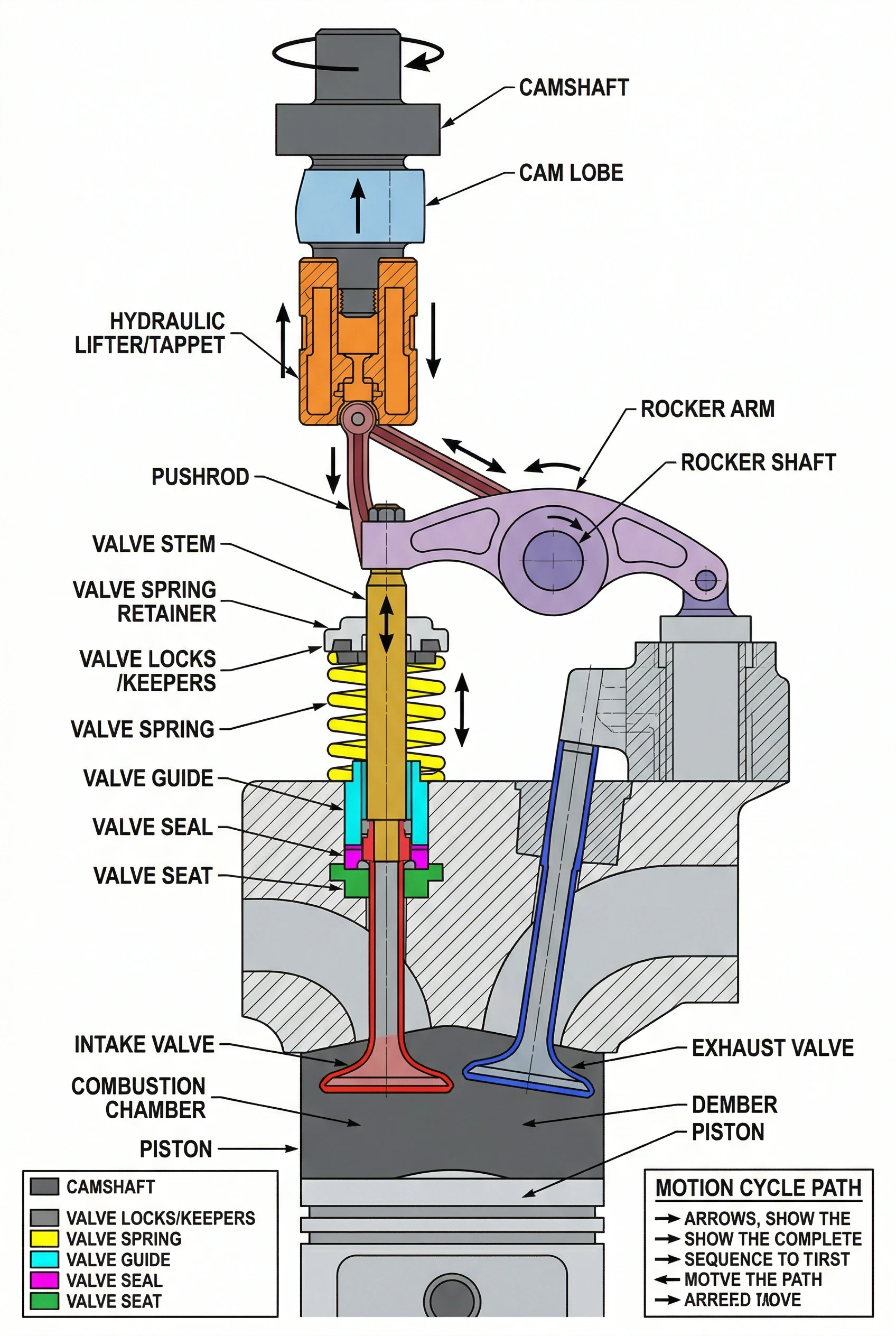
Engine valves are part of a complex system called the valve train, which includes:
Camshaft: Provides the motion to open valves
Lifters/Tappets: Follow cam lobes and transfer motion
Pushrods: Transfer motion in OHV engines (not present in OHC designs)
Rocker Arms: Pivot to push valves open
Valves: The valves themselves
Valve Springs: Return valves to closed position
Valve Guides: Guide valve stem movement
Valve Seats: Sealing surface in cylinder head
Valve Seals: Prevent oil from entering combustion chamber
Each component must work in perfect harmony for proper engine operation.
Opening and Closing Mechanism
The valve operation sequence:
Camshaft rotates: Cam lobe pushes against lifter
Lifter rises: Transfers motion through pushrod (OHV) or directly to rocker arm (OHC)
Rocker arm pivots: Pushes down on valve stem
Valve opens: Compressing valve spring
Cam lobe rotates past: Pressure released
Valve spring returns valve: Valve closes and seats firmly
This cycle repeats thousands of times per minute. At 3,000 RPM, each valve opens and closes 1,500 times per minute—25 times per second!
Variable Valve Timing (VVT)
Modern engines use Variable Valve Timing systems to optimize performance:
Low RPM: Earlier intake valve closing for better low-end torque
High RPM: Later intake valve closing for maximum power
Part throttle: Optimized timing for fuel efficiency
Benefits: Improved power, better fuel economy, reduced emissions
VVT systems can adjust valve timing by 40-60 degrees of camshaft rotation, dramatically improving engine flexibility.
Learn more: Rocker Arms | Valve Lifters | Variable Valve Timing
Common Engine Valve Problems
Understanding valve problems can help you identify issues early and prevent costly repairs.
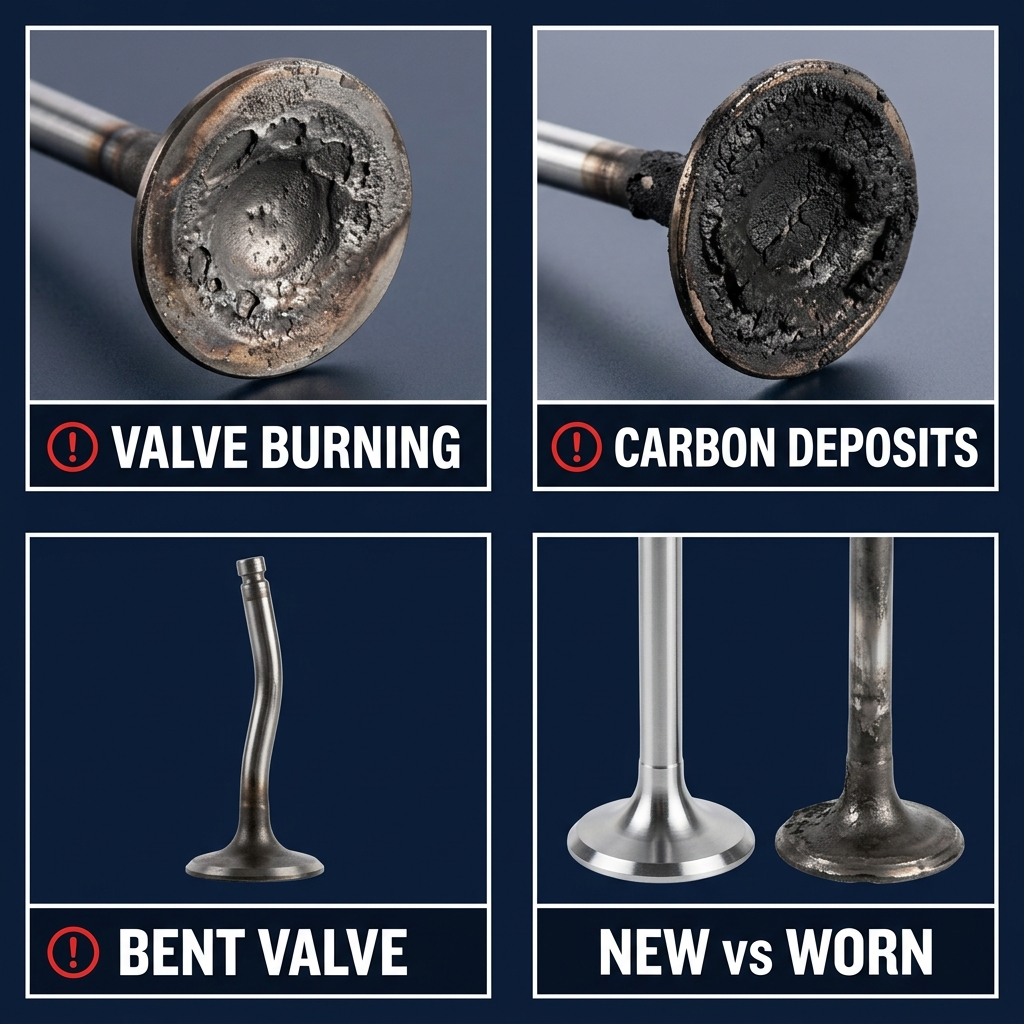
Valve Burning and Erosion
What it is: Material loss from the valve face due to extreme heat and combustion gases
Causes:
Overheating from cooling system problems
Lean air/fuel mixture causing excessive temperatures
Poor valve seating preventing heat transfer
Incorrect valve clearance
Detonation or pre-ignition
Symptoms:
Significant power loss
Rough idle and misfires
Failed compression test
Backfiring through intake or exhaust
Engine overheating
Consequences: If left unaddressed, burned valves can cause catastrophic engine damage, including piston damage and cylinder head warping.
Valve Leaking
What it is: Improper sealing between valve face and valve seat
Causes:
Worn or damaged valve seats
Carbon buildup preventing proper sealing
Bent valve stems
Valve face erosion
Incorrect valve lash adjustment
Symptoms:
Low compression in affected cylinder
Power loss and poor acceleration
Increased fuel consumption
Failed emissions test
Rough idle
Diagnosis: Compression test shows low pressure; leak-down test confirms valve leakage
Carbon Buildup
What it is: Accumulation of carbon deposits on valve surfaces, particularly intake valves
Why it happens:
Direct injection engines don't wash valves with fuel
Crankcase ventilation system recirculates oil vapors
Low-quality fuel
Short trips preventing engine from reaching full operating temperature
Symptoms:
Rough idle or engine stumbling
Hesitation during acceleration
Reduced fuel economy
Check engine light (misfire codes)
Cold start difficulties
Solution: Regular cleaning using walnut blasting, chemical cleaners, or manual cleaning
Learn more: Valve Cleaning Guide
Valve Stem Seal Failure
What it is: Deterioration of rubber seals that prevent oil from entering the combustion chamber
Causes:
Age and heat degradation
Poor quality seals
Excessive valve guide wear
Symptoms:
Blue smoke from exhaust, especially on startup or deceleration
Increased oil consumption
Fouled spark plugs
Failed emissions test
Learn more: Valve Seal Guide
Valve Guide Wear
What it is: Excessive clearance between valve stem and guide
Causes:
Normal wear over time
Inadequate lubrication
Contaminated oil
Overheating
Effects:
Valve wobble causing poor seating
Accelerated valve stem seal wear
Increased oil consumption
Potential valve breakage
Learn more: Valve Guide Guide
Valve Spring Failure
What it is: Broken or weakened valve springs
Causes:
Fatigue from millions of cycles
Overheating
Excessive RPM (valve float)
Corrosion
Symptoms:
Loud ticking or tapping noise
Severe misfire
Potential catastrophic engine damage if valve drops into cylinder
Urgency: Requires immediate attention to prevent major engine damage
Learn more: Complete Valve Problems Guide
Diagnosing Valve Problems
Symptoms to Watch For
Early detection can save you from expensive repairs. Watch for these warning signs:
Performance Issues:
Noticeable power loss
Poor acceleration
Reduced fuel economy
Engine struggles at certain RPM ranges
Audible Symptoms:
Ticking or tapping noises from cylinder head
Backfiring through intake or exhaust
Hissing sounds from engine
Visual Indicators:
Blue smoke (oil burning)
Black smoke (rich mixture from poor sealing)
White smoke (coolant entering combustion chamber)
Check engine light with misfire codes
Mechanical Symptoms:
Rough idle or engine shaking
Difficulty starting, especially when cold
Engine overheating
Diagnostic Methods
1. Compression Test
Measures cylinder sealing ability
Low compression indicates valve, piston ring, or head gasket problems
Quick and inexpensive first diagnostic step
2. Leak-Down Test
More precise than compression test
Identifies where leakage is occurring:
Air from oil filler = piston rings
Air from intake = intake valve
Air from exhaust = exhaust valve
Air from radiator = head gasket
3. Borescope Inspection
Visual inspection through spark plug hole
Can see valve condition, carbon buildup, and combustion chamber condition
Non-invasive diagnostic method
4. Valve Clearance Check
Ensures proper valve lash
Incorrect clearance can cause noise and performance issues
Required maintenance on engines with mechanical lifters
Learn more: Valve Problems Diagnostic Guide
Engine Valve Maintenance
Proper maintenance can extend valve life and prevent costly repairs.
Regular Maintenance Tasks
1. Valve Clearance Check and Adjustment
Frequency: Every 60,000-100,000 miles (varies by manufacturer)
Why it matters: Proper valve clearance ensures:
Correct valve timing
Complete valve closure for proper sealing
Adequate clearance when engine is hot
Who needs it:
Engines with mechanical (solid) lifters require regular adjustment
Engines with hydraulic lifters are self-adjusting but should still be inspected
Cost: $200-500 for inspection and adjustment
2. Regular Valve Cleaning
For Direct Injection Engines:
Intake valve cleaning every 30,000-50,000 miles
Methods: Walnut blasting, chemical cleaning, or manual cleaning
Cost: $200-400 for professional cleaning
Prevention:
Use quality fuel with detergent additives
Use fuel system cleaners periodically
Avoid excessive idling
Regular highway driving helps burn off deposits
3. Use High-Quality Engine Oil
Why it matters:
Lubricates valve stems and guides
Prevents excessive wear
Reduces carbon formation
Protects valve seals
Best practices:
Follow manufacturer's recommended oil grade
Change oil at recommended intervals (or sooner)
Use quality oil filters
Consider synthetic oil for better protection
4. Use Recommended Fuel
Benefits:
Reduces carbon deposits
Prevents detonation that can damage valves
Maintains proper combustion temperatures
Protects against valve burning
Preventive Measures
Avoid prolonged idling: Promotes carbon buildup and incomplete combustion
Regular highway driving: Higher RPMs help clean carbon deposits
Address engine problems promptly: Overheating, misfires, and other issues can damage valves
Use quality parts: Cheap replacement parts often fail prematurely
Maintain cooling system: Prevents overheating that damages valves
When to Seek Professional Help
Don't delay if you notice:
Persistent ticking or tapping noises
Significant power loss
Excessive oil consumption
Blue smoke from exhaust
Check engine light with misfire codes
Failed emissions test
Early intervention can prevent minor valve issues from becoming major engine repairs.
Learn more: Valve Cleaning | Valve Noise Diagnosis
Valve Replacement and Repair
When Replacement Is Needed
Valve replacement becomes necessary when:
Severe burning or erosion: Valve face is damaged beyond repair
Bent valve stems: Often from timing belt failure or over-revving
Excessive wear: Valve stem or face worn beyond specifications
Engine rebuild: Valves should be replaced or reconditioned during major overhauls
Performance upgrade: Installing performance valves for increased power
Replacement Process Overview
Professional valve replacement involves:
Cylinder head removal: Engine must be partially disassembled
Valve train disassembly: Remove rocker arms, springs, and related components
Valve removal: Use valve spring compressor to remove old valves
Inspection: Check valve guides, seats, and cylinder head condition
Valve seat reconditioning: Machine or replace valve seats if needed
Valve guide service: Replace worn guides
New valve installation: Install new valves with proper specifications
Valve seal replacement: Always replace valve seals during valve service
Reassembly: Reinstall valve train components
Valve adjustment: Set proper clearances
Testing: Verify compression and proper operation
Cost Breakdown
Understanding the costs helps you budget for this repair:
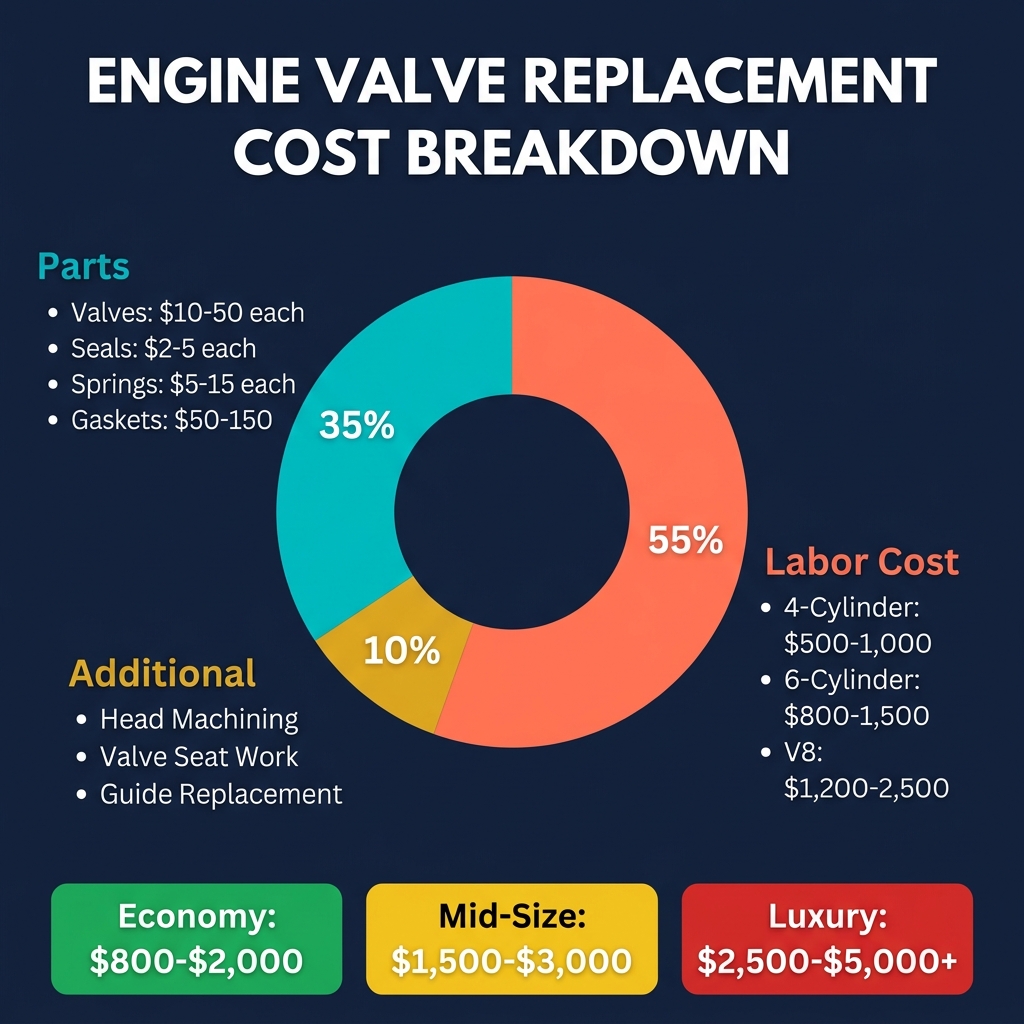
Parts Costs:
Valves: $10-50 each (intake typically less expensive than exhaust)
Valve seals: $2-5 each
Valve springs: $5-15 each
Valve guides: $5-10 each (if replacement needed)
Gaskets and seals: $50-150
Head bolts: $30-100 (often replaced)
Labor Costs (varies significantly by engine type):
4-cylinder engine: $500-1,000
6-cylinder engine: $800-1,500
V8 engine: $1,200-2,500
V-configuration engines cost more due to accessibility
Total Typical Costs:
Economy vehicles: $800-2,000
Mid-size vehicles: $1,500-3,000
Luxury/performance vehicles: $2,500-5,000+
Exotic vehicles: $5,000-10,000+
Additional costs may include:
Cylinder head machining: $150-400
Valve seat replacement: $50-100 per seat
Valve guide replacement: $30-50 per guide
Timing belt/chain replacement (if accessible): $300-1,000
OEM vs Aftermarket Valves
OEM (Original Equipment Manufacturer):
✅ Guaranteed fitment and quality
✅ Meets original specifications
✅ Warranty coverage
❌ Higher cost
❌ Limited performance options
Quality Aftermarket (like TOPU):
✅ Excellent value for money
✅ OEM-equivalent or better quality
✅ Performance upgrade options available
✅ IATF 16949 certified manufacturing
✅ Competitive pricing
⚠️ Choose reputable brands only
Budget Aftermarket:
❌ Avoid cheap, unknown brands
❌ May not meet specifications
❌ Shorter lifespan
❌ Potential engine damage
DIY vs Professional Repair
DIY Considerations:
Requires specialized tools (valve spring compressor, torque wrench, etc.)
Needs technical knowledge and experience
Risk of improper installation causing engine damage
Time-consuming (10-20 hours for first-timers)
Recommendation: Only for experienced mechanics
Professional Advantages:
Proper tools and equipment
Experience with valve service
Warranty on work performed
Faster completion
Recommendation: Best choice for most vehicle owners
Learn more: Complete Valve Repair Guide
Choosing the Right Engine Valves
Factors to Consider
1. Engine Type
Naturally Aspirated Engines:
Standard stainless steel valves usually sufficient
Focus on OEM specifications
Cost-effective options available
Turbocharged/Supercharged Engines:
Higher temperatures require better materials
Consider upgraded exhaust valves
Nickel-based alloys recommended for exhaust valves
Diesel Engines:
Higher compression requires stronger valves
Different combustion characteristics
Specific valve designs for diesel applications
2. Usage Scenario
Daily Driving:
OEM-specification valves ideal
Balance of performance, durability, and cost
Standard materials sufficient
High-Performance/Enthusiast:
Consider upgraded materials
Titanium intake valves for weight reduction
Inconel exhaust valves for heat resistance
Improved valve springs for higher RPM
Racing/Competition:
Lightweight titanium valves
Sodium-filled exhaust valves
Specialized coatings
Frequent replacement schedule
3. Material Selection
Standard Applications:
Stainless steel intake valves
Heat-treated stainless steel exhaust valves
Cost-effective and reliable
Performance Applications:
Titanium intake valves (40% weight reduction)
Inconel exhaust valves (superior heat resistance)
Specialized coatings for reduced friction
Budget Considerations:
Balance quality and cost
Avoid cheapest options
Consider long-term value
4. Brand and Quality
What to look for:
ISO/IATF certifications
OEM supplier credentials
Positive reviews and reputation
Warranty coverage
Technical support availability
Red flags:
Unusually low prices
Unknown manufacturers
No certifications
Poor reviews
No warranty
TOPU Engine Valves
At TOPU, we manufacture engine valves that meet or exceed OEM specifications:
IATF 16949:2016 certified
ISO 9001:2015 quality management
ISO 14001:2015 environmental management
Advanced CNC machining
Precision heat treatment
Rigorous quality control
100% dimensional inspection
Product Range:
Passenger vehicle valves
Commercial vehicle valves
Performance valves
Custom solutions available
Global Supply:
Serving customers in 50+ countries
OEM partnerships with major manufacturers
Competitive pricing with premium quality
Technical support and consultation
Why Choose TOPU:
Over 20 years of manufacturing experience
State-of-the-art production facilities
Strict quality control processes
Competitive pricing without compromising quality
Conclusion
Engine valves are critical components that directly impact your vehicle's performance, efficiency, and reliability. Understanding how they work, recognizing problems early, and maintaining them properly can save you thousands in repair costs and extend your engine's lifespan.
Key takeaways:
Regular maintenance prevents most valve problems
Address symptoms promptly to avoid costly repairs
Choose quality replacement parts from reputable manufacturers
Professional diagnosis ensures accurate problem identification
Proper valve selection depends on your engine type and usage
Whether you need replacement valves for routine maintenance, engine rebuild, or performance upgrade, choosing high-quality components is essential. At TOPU, we're committed to manufacturing engine valves that meet the highest standards of quality and performance.
Ready to Learn More or Get a Quote?
Contact TOPU today for:
Premium OEM-quality engine valves
Technical consultation and support
Custom valve solutions
Competitive pricing for bulk orders
Fast global shipping