Valve lifters (also called tappets or cam followers) transfer motion from the camshaft to the valves, opening and closing them thousands of times per minute. These cylindrical components ride on cam lobes, converting rotational motion into the linear motion that operates your engine valves.
The lifter type dramatically affects engine characteristics. Hydraulic lifters provide maintenance-free, quiet operation for daily driving. Mechanical lifters offer precise valve control for high-performance applications. Roller lifters reduce friction for improved efficiency.
This guide covers valve lifter types, operation, common problems, and maintenance. At TOPU, we manufacture precision valve lifters for diverse automotive applications worldwide.
What Are Valve Lifters?
Definition and Function
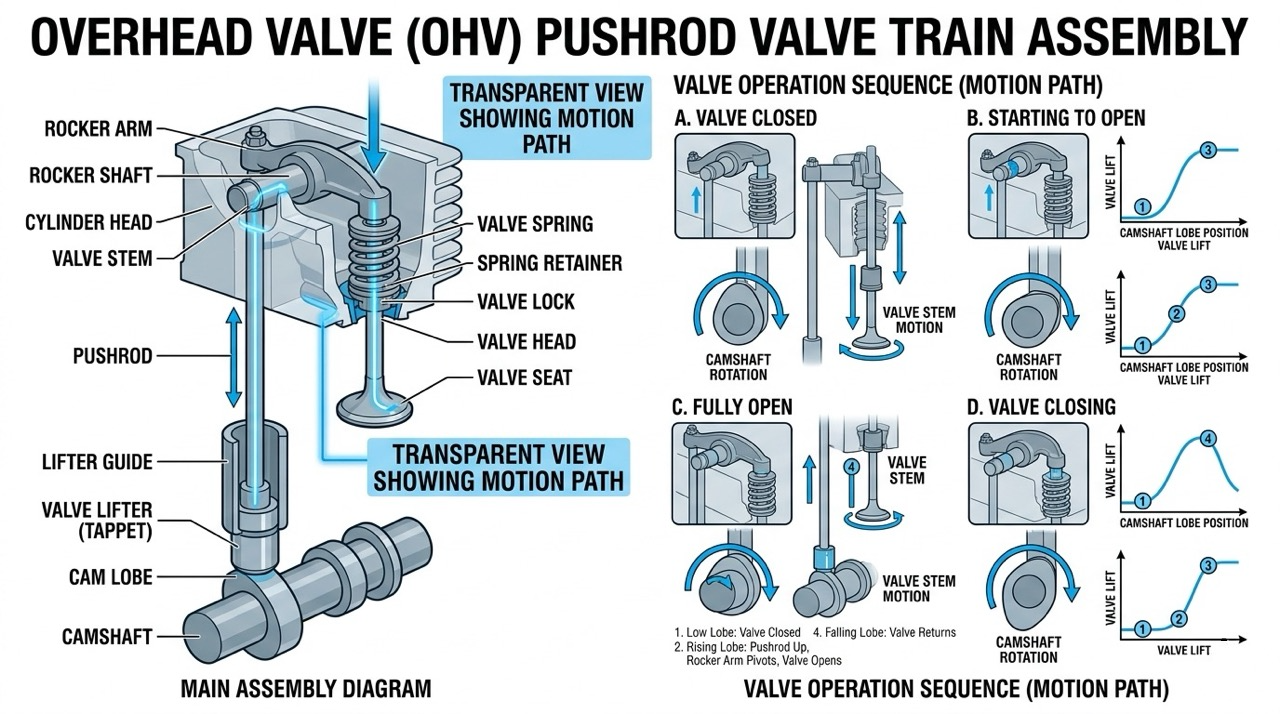
A valve lifter sits between the camshaft and valve train, transferring motion from the rotating cam lobe to the pushrod or directly to the valve. The lifter rides on the cam lobe, following its profile as the camshaft rotates. This up-and-down motion opens and closes the valves.
The lifter's bottom face contacts the cam lobe, while the top receives the pushrod (in pushrod engines) or directly contacts the valve stem (in overhead cam engines).
Position in Valve Train
Pushrod engines: Lifters sit in the engine block's lifter valley above the camshaft. As the cam rotates, each lobe lifts its lifter, which pushes the pushrod upward. The pushrod pivots the rocker arm, which opens the valve.
Overhead cam engines: Lifters (called cam followers or bucket tappets) sit directly between the camshaft and valve stem, eliminating the pushrod. This direct-acting design reduces valve train mass and allows higher RPM operation.
Role in Engine Performance
Lifter condition directly affects valve timing precision, influencing power output, fuel efficiency, and emissions. Worn lifters reduce effective valve lift and duration, decreasing performance. Excessive clearance causes valve timing to lag.
Roller lifters reduce friction compared to flat-tappet designs, freeing up several horsepower while improving fuel economy and reducing heat generation.
Types of Valve Lifters
Hydraulic Lifters
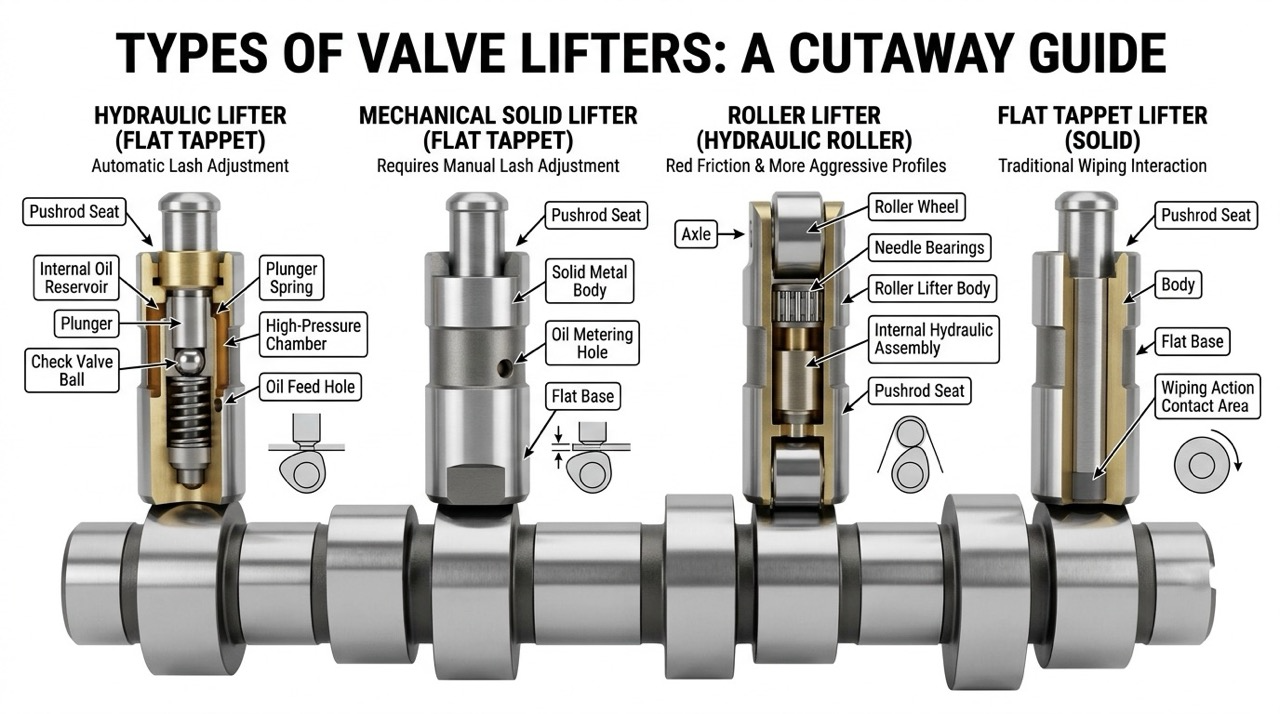
Hydraulic lifters contain an internal hydraulic mechanism that automatically maintains zero valve clearance. Engine oil pressure fills an internal chamber, creating a hydraulic cushion that adjusts for thermal expansion, wear, and manufacturing tolerances.
Advantages: Maintenance-free operation for 150,000-200,000+ miles. Quiet operation with zero lash. Reduced impact forces throughout the valve train.
Disadvantages: Can pump up at high RPM (above 6,500-7,000 RPM), preventing valves from fully closing. Slight delay in motion transfer reduces precision compared to solid lifters. Not ideal for racing applications.
Mechanical (Solid) Lifters
Mechanical lifters are solid, one-piece components with no hydraulic mechanism. They require a specific clearance (valve lash) of 0.010-0.020 inches between rocker arm and valve stem, which must be manually adjusted every 20,000-40,000 miles.
Advantages: Precise valve control—the valve follows the cam profile exactly. No pump-up at high RPM. Ideal for racing and high-performance engines.
Disadvantages: Require periodic adjustment. Noticeably louder than hydraulic systems due to valve lash. More maintenance-intensive.
Roller Lifters
Roller lifters use a small roller bearing at the cam contact point instead of a flat face. Rolling contact dramatically reduces friction, typically freeing up 2-5 horsepower on a V8 while reducing wear on both lifter and cam lobe.
Roller lifters can be hydraulic (maintenance-free with reduced friction) or mechanical (precise control with reduced friction). The main disadvantage is cost—2-4 times more than flat-tappet equivalents.
Flat Tappet Lifters
Flat tappet lifters have a slightly crowned face that slides against the cam lobe. The face is ground with a slight crown and installed at an angle to induce rotation, distributing wear evenly.
Critical: Flat tappet lifters require special lubrication. Modern oils with reduced ZDDP don't protect them adequately. Use oils with ZDDP levels of 1,200-1,400 ppm for engines with flat tappet cams.
Comparison Table
Feature | Hydraulic | Mechanical | Roller |
|---|---|---|---|
Adjustment | Automatic | Manual | Varies |
Maintenance | None | Every 20-40k mi | Minimal |
Noise Level | Quiet | Loud | Quiet |
RPM Limit | ~6,500 | 8,000+ | 8,000+ |
Cost | Moderate | Low | High |
Precision | Good | Excellent | Excellent |
Best For | Daily driving | Racing | Performance |
How Valve Lifters Work
Basic Operation
As the camshaft rotates at half engine speed, each cam lobe lifts its lifter once per revolution. The lifter follows the cam lobe's profile, transferring motion upward. In pushrod engines, the lifter pushes the pushrod, which pivots the rocker arm, which opens the valve. In overhead cam engines, the lifter pushes directly on the valve stem.
When the cam lobe rotates past peak lift, the valve spring pushes everything back down. At 3,000 RPM, each lifter completes 1,500 cycles per minute.
Interaction with Camshaft
The lifter-to-cam interface is one of the highest-stress contact points in the engine, with pressures exceeding 200,000 PSI. Proper lubrication is critical—the oil film must support these extreme pressures while allowing smooth motion.
Break-in procedures for new cams and lifters are critical. The first 20-30 minutes of operation establish the wear pattern that persists throughout the components' lives.
Valve Train Sequence
The complete sequence: Camshaft rotates → cam lobe lifts lifter → lifter pushes pushrod → pushrod pivots rocker arm → rocker arm opens valve against spring pressure. When the cam lobe rotates past peak lift, the valve spring reverses the sequence.
Lifters often show problems first because they experience the highest contact stresses and depend on adequate lubrication and oil pressure.
Common Valve Lifter Problems
Wear and Failure
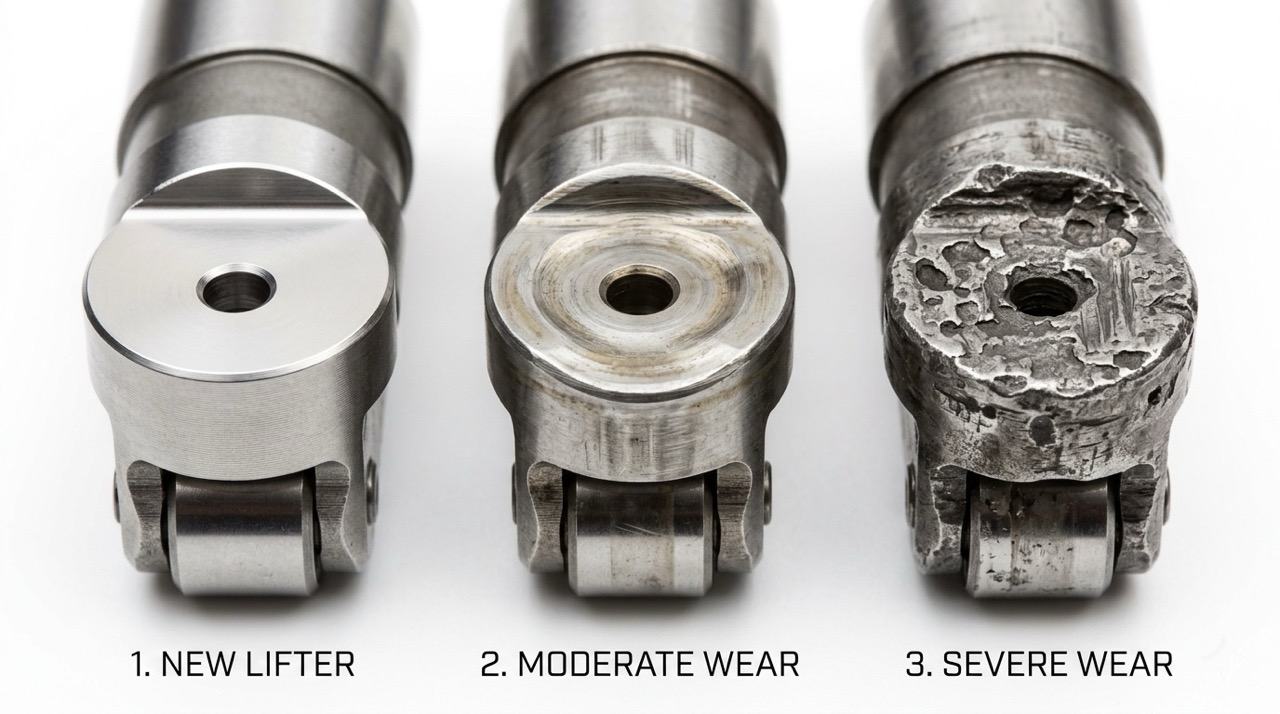
Lifter face wear develops gradually from constant cam contact. The face may develop a concave depression, causing noise. Severe wear causes pitting or spalling, typically indicating lubrication problems or contaminated oil.
Internal wear in hydraulic lifters prevents them from maintaining proper pressure. The plunger-to-body clearance increases, allowing oil to leak past faster than it can be replenished. Once internal wear is significant, replacement is necessary.
Noise Issues
Lifter noise manifests as rhythmic ticking or tapping synchronized with engine RPM. Causes include collapsed hydraulic lifters, excessive clearance from worn components, contaminated oil, low oil pressure, or air trapped in lifters.
Distinguishing lifter noise from valve noise requires careful listening. A mechanic's stethoscope helps pinpoint the sound's origin.
Collapsed Lifters
A collapsed lifter can't maintain proper length under load. In hydraulic lifters, the internal mechanism can't hold pressure—the plunger sinks into the body, creating excessive clearance.
Symptoms: loud constant ticking, reduced performance from the affected cylinder, misfires, rough running. If multiple lifters collapse, the engine runs poorly and may not idle smoothly.
Sticking Lifters
Lifters can stick in their bores from varnish deposits, contaminated oil, or corrosion. A stuck lifter may remain partially extended, preventing the valve from fully closing—causing compression loss, rough running, and potential valve damage from excessive heat.
Engine flushing and fresh oil sometimes free stuck lifters, but replacement is often necessary.
Camshaft Wear
Lifter problems often cause or result from camshaft wear. Worn lifters accelerate cam lobe wear, and worn cam lobes damage lifter faces. The two wear together.
Critical: When replacing lifters, always inspect the camshaft. If cam lobes show visible wear, pitting, or scoring, replace the camshaft along with the lifters. Otherwise, the worn cam will destroy new lifters.
Valve Lifter Replacement
When Replacement Is Needed
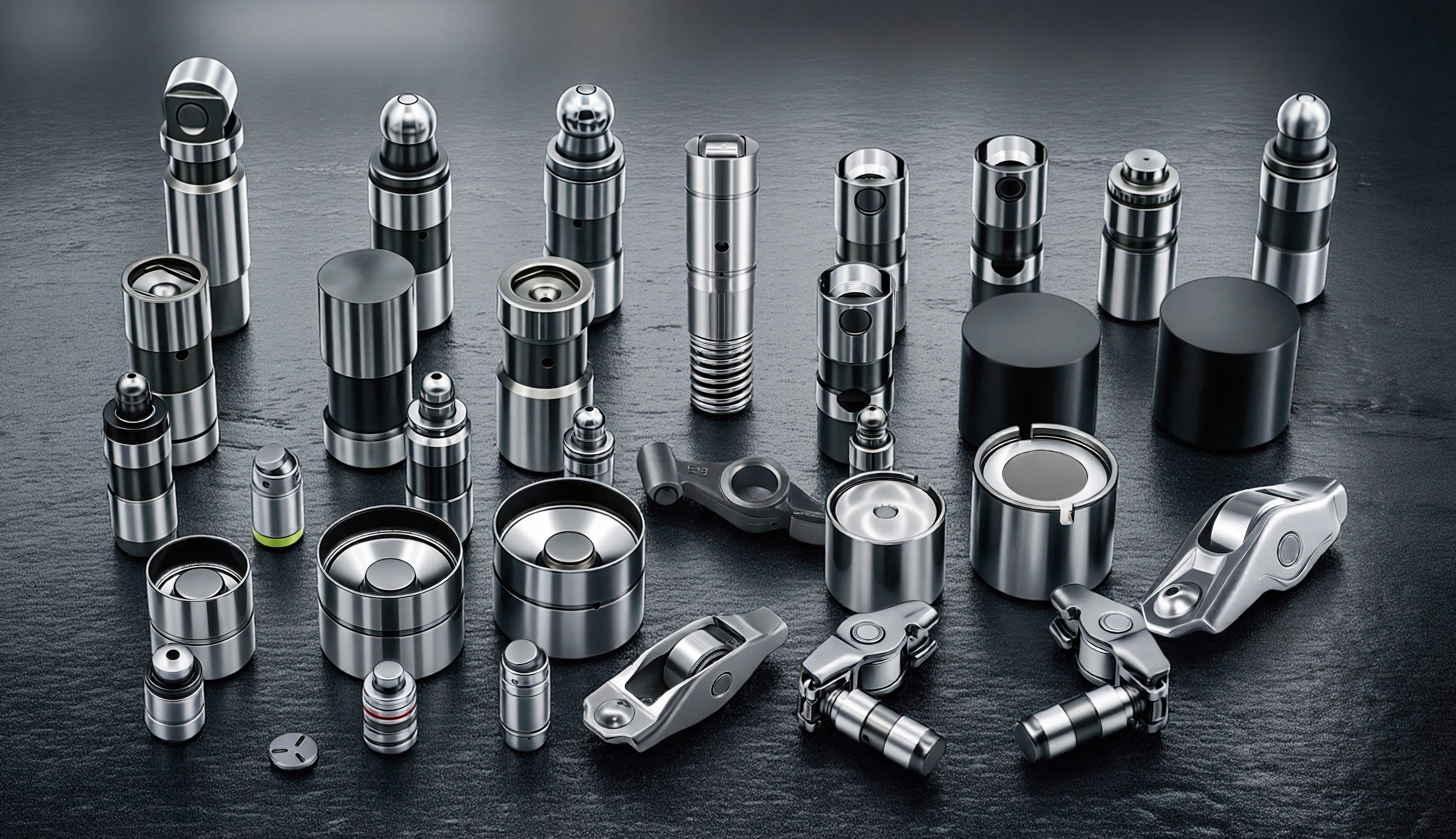
Replace lifters when you have persistent ticking that doesn't respond to oil changes or additives, performance loss from specific cylinders with noise, or visible damage during inspection (pitted, scored, or concave faces). High-mileage engines (200,000+ miles) may benefit from preventive replacement during other engine work.
Replacement Process
Lifter replacement requires significant disassembly: remove intake manifold, valve covers, rocker arms, and pushrods. Inspect the camshaft carefully—any visible wear, pitting, or scoring requires camshaft replacement. Installing new lifters on a worn cam causes rapid failure.
Clean all lifter bores thoroughly. Pre-fill hydraulic lifters with oil before installation. After reassembly, run the engine at fast idle for 10-20 minutes to bleed hydraulic lifters.
Cost Breakdown
Parts costs:
Basic hydraulic lifters: $15-25 each
Premium hydraulic lifters: $25-40 each
Mechanical lifters: $5-15 each
Roller lifters: $30-80 each
Total costs (V8 engine with 16 lifters):
Parts: $240-1,280
Labor: $500-1,500
Total: $800-2,200
Learn more about valve lifter replacement costs.
DIY vs Professional
Lifter replacement is feasible for experienced DIYers with proper tools, but mistakes can cause serious engine damage. Professional mechanics have the experience, tools, and workspace to perform the job correctly. For most vehicle owners, professional replacement is the appropriate choice.
Choosing the Right Valve Lifters
OEM vs Aftermarket
OEM lifters guarantee exact fit but cost 20-40% more than quality aftermarket alternatives. Reputable aftermarket manufacturers like TOPU produce lifters meeting or exceeding OEM specifications at lower prices, manufactured to IATF 16949 standards.
Avoid the cheapest lifters. The labor cost to replace lifters is substantial—saving $100 on parts isn't worthwhile if they fail in 30,000 miles instead of 150,000.
Performance Upgrades
Upgrading from flat-tappet to roller lifters reduces friction and frees up 2-5 horsepower on a V8 while extending cam and lifter life. Switching from hydraulic to mechanical lifters enables more aggressive cam profiles and higher RPM operation, ideal for racing or high-performance street use.
Compatibility Considerations
Critical: Lifter selection must match the camshaft design. Hydraulic and mechanical cam profiles are ground differently. Roller lifters require roller-specific cams. Flat-tappet lifters on a roller cam (or vice versa) won't work properly.
Lifter bore diameter and length must match the engine design. Lifters aren't universal—they're designed for specific engine families.
TOPU Valve Lifters
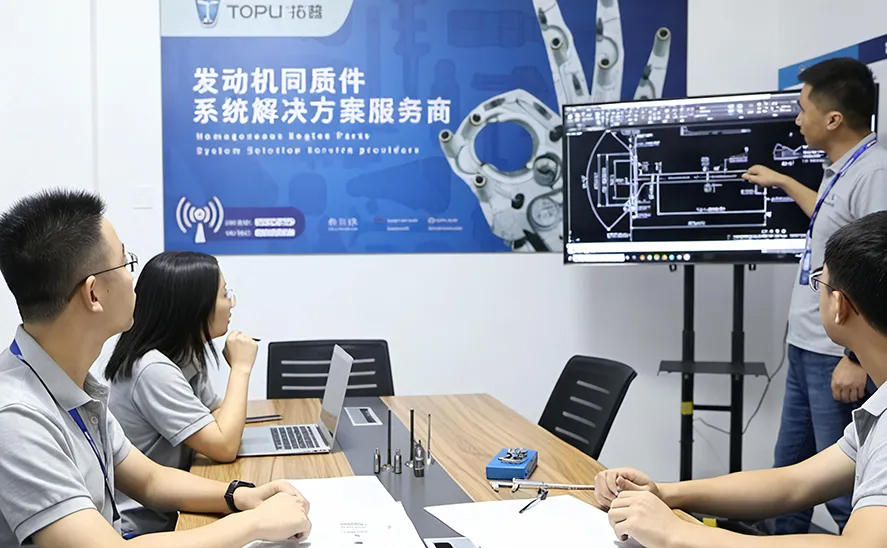
TOPU manufactures comprehensive valve lifter lines for diverse applications: hydraulic lifters for reliable daily driving, mechanical lifters for precision performance, and roller lifters for reduced friction and extended life.
All TOPU lifters are manufactured to strict tolerances using premium materials, with IATF 16949 certified production ensuring consistent quality for Asian, European, and American vehicles.
Maintenance Tips
Oil Quality and Changes
Regular oil changes with quality oil are the most important maintenance for lifter longevity. Change oil every 5,000 miles or at manufacturer's recommended intervals. For engines with flat-tappet cams, use oil with adequate ZDDP content (1,200-1,400 ppm)—modern low-ZDDP oils don't provide adequate protection.
Break-In Procedures
New cams and lifters require careful break-in, especially flat-tappet cams. Use dedicated break-in oil with high ZDDP. Start the engine and immediately bring RPM to 2,000-2,500 RPM for 20-30 minutes. Change oil at 500 miles to remove wear particles.
Inspection and Prevention
Listen for unusual valve train noises during routine maintenance. Monitor oil consumption and condition. Maintain proper oil level—low oil causes air entrainment and reduced pressure. Allow proper warm-up before heavy loads. Address oil pressure problems immediately.
Contact TOPU for High-Quality Valve Lifters
TOPU manufactures precision valve lifters for diverse automotive applications. Our comprehensive product line includes hydraulic, mechanical, and roller lifters for Asian, European, and American vehicles. Contact us today to discuss your valve lifter requirements.