There is a terrifying amount of mechanical violence happening inside your engine block right now. During the combustion stroke, the heat inside the cylinder easily reaches 800°C (1,472°F). The engine valves sit directly in the crosshairs of this firestorm, absorbing the heat while simultaneously slamming shut thousands of times a minute.
If you are an auto parts distributor or an engine rebuilding shop, one of the most critical questions you can ask your engine parts manufacturer is: "What exact steel alloy are you using?" A cheap, standard stainless steel valve will literally melt and stretch under the intense heat of a modern engine, resulting in catastrophic failure and plummeting compression.
To guarantee you are quoting the right part for the job, you need to understand the metallurgy. Let’s break down the world of engine valve materials and explore the aerospace-grade alloys keeping your engine alive.
Differences in Intake and Exhaust Engine Valve Materials
Before diving into complex periodic tables, you have to understand the fundamental difference in life expectancy between the two main valve types.
The intake valves have a relatively easy life. Their job is to pull fresh, cool air (and fuel) into the engine. This incoming rush of cool air constantly refrigerates the metal, meaning the intake valve rarely exceeds 300°C. Because of this, standard Martensitic steels (like 40Cr, 4Cr9Si2, or SUH1) are perfectly appropriate and highly cost-effective.
The exhaust valves, however, endure absolute hell. They serve as the exhaust pipe for the explosion, having extremely hot combustion gases blasted aggressively past their face. Because they lack a cooling breeze, they routinely hit 800°C. They mathematically require much more expensive Austenitic steels to survive without turning into brittle, glowing slag.
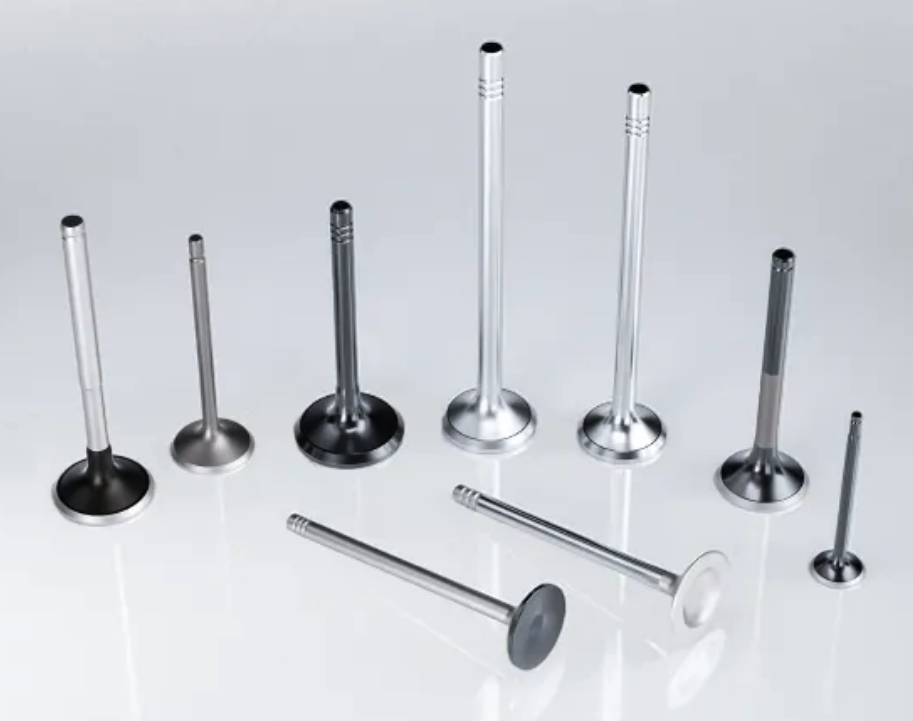
The Gold Standard: 21-4N Steel
If you are buying high-performance or OEM-grade exhaust valves today, you are almost definitely looking at 21-4N steel. In the Japanese industrial standard (JIS), this exact same alloy is known as SUH35.
21-4N is an Austenitic steel alloy heavily packed with Chromium, Manganese, and Nitrogen. The "21-4" refers to its composition: roughly 21% Chromium and 4% Nickel. The high chromium content gives the metal intense resistance to oxidation (rust) and lead corrosion from combustion gases. The secret weapon, however, is Nitrogen. Nitrogen dramatically reinforces the steel's molecular integrity at extremely high temperatures, preventing the valve stem from "stretching" under the tension of heavy valve springs.
For 90% of passenger and commercial vehicles on the road today, 21-4N/SUH35 is the absolute gold standard for exhaust valves, blending top-tier durability with realistic wholesale pricing for distributors. If you are sourcing in bulk, explore our TOPU 21-4N Exhaust Valves to secure certified alloy quality for your clients.
External Reference: Metallurgical engineering briefs from Engine Builder Magazine stress that standard stainless steel cannot survive exhaust temperatures exceeding 800°C; upgrading to Austenitic 21-4N steel or Inconel is an absolute requirement for long-term engine reliability.
Extreme Conditions Require Inconel Exhaust Valves
What happens when you push an engine past the limits of normal physics? In high-stress environments like turbocharged drag racers, heavy-duty commercial diesels, or Formula 1 cars, even 21-4N starts to bend. That is when a premier OEM supplier reaches for exotic superalloys.
Inconel is a nickel-chromium-based superalloy originally intended for jet engine turbine blades. It effortlessly shrugs off temperatures exceeding 1,000°C without losing an ounce of its tensile strength. If a turbocharged engine is running absurdly high exhaust gas temperatures (EGTs), Inconel exhaust valves are mandatory to prevent the valve head from snapping off. If your distribution network caters to heavy-duty commercial fleets or high-performance racing teams, check out TOPU Inconel Exhaust Valves for unmatched thermal resistance.
Titanium is the king of lightweight performance. A titanium intake valve weighs roughly 40% less than a standard steel valve. When an engine revs to 9,000 RPM, that dramatic weight reduction prevents the valve lifters from floating, ensuring the engine breathes flawlessly. However, titanium is incredibly expensive and wears down quickly without specialized aerospace coatings.
Engine Valve Material Cross-Reference Guide
When sourcing engine valves globally, matching materials across different international standards is a common challenge for procurement teams and distributors. An engine valve's designation can vary significantly depending on whether you are using Chinese, German, Japanese, American, or other European specifications.
To simplify international procurement, here is a comprehensive cross-reference table of the major Martensitic and Austenitic engine valve alloys used across leading industrial countries:
Material Grade | China (GB) | Europe/Germany (DIN) | Japan (JIS) | International (ISO) | USA (SAE) | France (NF) | Italy (Cogne/VALBRVNA) |
|---|---|---|---|---|---|---|---|
4Cr9Si2 | 4Cr9Si2 | — | — | — | — | — | — / — |
5Cr9Si3 | — | X45CrSi93 (1.4718) | SUH1 | X45CrSi93 | HNV3 | Z45CS9 | VM11 / VAL5 |
5Cr8Si2 | — | — | SUH11 | X50CrSi82 | — | — | — / VAL5/BS1 |
4Cr10Si2Mo | 4Cr10Si2Mo | X40CrSiMo102 (1.4731) | SUH3 | — | — | Z40CSD10 | VM12D / VAL5M |
8Cr20Si2Ni | 8Cr20Si2Ni | — | SUH4 | — | HNV6 | Z80CNS20-20 | VM21 / AVL |
9Cr18Mo2V | — | X85CrMoV182 (1.4748) | — | X85CrMoV182 | — | Z85CDV18-02 | VM22 / ACMV |
4Cr14Ni14W2Mo | 4Cr14Ni14W2Mo | — | — | — | EV9 | Z35CNWS14-14 | VA31 / ACNW |
5Cr20Mn8Ni2N (21-2N) | — | X55CrMnNiN208 (1.4875) | — | X55CrMnNiN208 | EV12 | Z55CMN20-08AZ | VA66 / 212MN |
5Cr21Mn9Ni4N (21-4N) | 5Cr21Mn9Ni4N | X53CrMnNiN219 (1.4871) | SUH35 | X53CrMnNiN219 | EV8 | Z53CMN21-09AZ | VA61 / 214MN |
2Cr21Ni12N (21-12N) | 2Cr21Ni12N | — | SUH37 | — | EV4 | Z20CN21-12AZ | VA35 / APFR2 |
5Cr21Mn9Ni4Nb2WN (21-4NWNb) | — | X50CrMnNiNbN219 (1.4882) | — | X50CrMnNiNbN219 | XEV-F | Z50CMNNB21-09-02AZ | VA63 / 214MNCW |
6Cr21Mn10MoVNbN | — | X60CrMnMoNiNbN2110 (1.4785) | — | — | — | Z60CMDVNB21-10AZ | VA64 / S5220 |
3Cr23Ni8Mn3N (23-8N) | — | X33CrNiMn238 (1.4866) | — | X33CrNiMn238 | EV16 | — | VA34 / NTR20 |
3Cr20Ni11Mo2P (20-11P) | — | — | SUH38 | — | — | — | — / — |
GH145 (Inconel 751) | — | — | NCF751 | NiCr15Fe7TiAl | HEV3 | — | — / — |
Understanding these equivalents helps distributors ensure material compliance, whether sourcing standard replacement valves or high-performance parts.
The Bimetallic Compromise (Friction Welding)
Manufacturers face a massive engineering problem: the Austenitic steel (21-4N) needed to survive the heat of the exhaust valve head is unfortunately very soft, meaning the top of the valve stem will quickly get chewed to pieces by the rocker arm.
To solve this, advanced factories use a process called friction welding to create a bimetallic valve. They take a tough, hardened Martensitic steel stem and literally spin it against an Austenitic (SUH35) steel valve head. The friction generates so much heat that the two distinct metals melt and fuse together permanently.
This gives you an absolute "best of both worlds" product. The valve head survives the 800°C inferno, while the upper valve stem remains ruthlessly hard and often utilizes treatments like hard chrome plating to survive thousands of miles of mechanical friction through the valve guide.
As an industry-leading manufacturer, TOPU specializes in advanced friction welding to supply high-durability Bimetallic Engine Valves that prevent premature wear and stem breakage.
Partner with TOPU: Your Certified Engine Valve Manufacturer

When sourcing engine valves for your automotive repair brand, heavy-duty fleet, or wholesale distribution network, material integrity is everything. Sourcing directly from an IATF 16949 certified manufacturer eliminates the risk of costly engine failures and warranty claims.
TOPU is a premier global engine parts manufacturer specializing in high-durability valvetrain solutions:
Bimetallic & Inconel Engine Valves: Certified 21-4N (SUH35) bimetallic friction-welded valves and high-temperature Inconel exhaust valves engineered to survive up to 1,000°C.
OEM-Quality Valve Lifters & Tappets: Highly precise hydraulic, mechanical, and roller lifters CNC-machined to ±0.001 mm tolerances to guarantee zero leak-down and quiet engine operation.
Secure Your Supply Chain & Send an Inquiry Today
We provide flexible B2B wholesale solutions, custom OEM/ODM manufacturing, and comprehensive material certification (including real-time SPC and metallurgical audits).
👉 Contact the TOPU Valvetrain Engineering Team today to get a factory-direct price quote, request material samples, or discuss your custom production requirements.